
Hey, Team!
Copper Hills Elementary School was recently awarded a $2,000 grant from the Toshiba Foundation. These monies will be used to support the 6th-grade students on that site as they investigate the engineering process and 3D printing technology.
Copper Hills Elementary School was recently awarded a $2,000 grant from the Toshiba Foundation. These monies will be used to support the 6th-grade students on that site as they investigate the engineering process and 3D printing technology.
The focus of this grant is to maximize language production
in our Special Education Department as our sixth-grade students print
science-rich learning materials. We hypothesize that the hands-on analysis of
such prints will increase science-rich language production in our students with
special needs.
Our 3D printer will be used for other projects/prints as
well. For example, this year we plan to utilize Project-Based Learning (PBL)
strategies as we explore assistive medical technology for animals with
malformed limbs. Children can research animals around the globe who have
mobility issues. The end goal of the lesson is that these students will design
a reasonable solution (3D print design) for an animal they located online. At
the close of the lesson, the students will share out their findings.
Here’s a time lapse video LINK HERE of one such design idea:
Here’s a time lapse video LINK HERE of one such design idea:
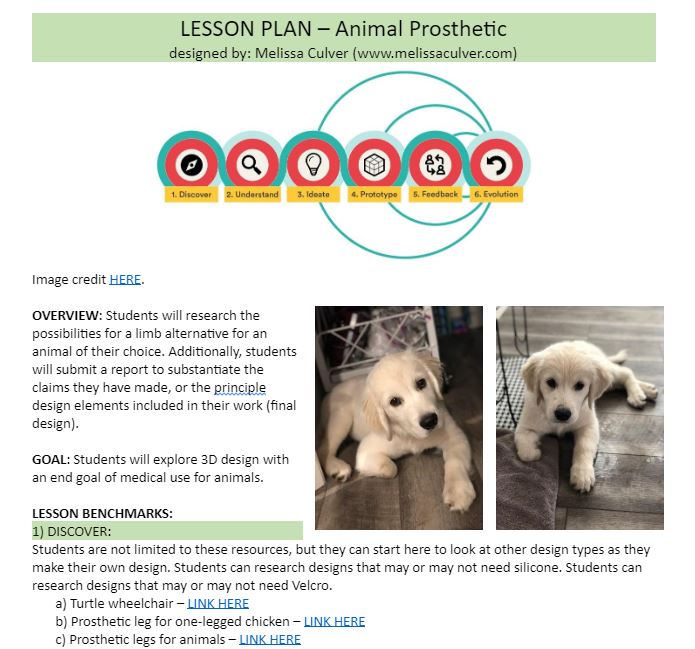
Here are images that showcase this journey.


Closing Q&A
Q) Will this actually work on a dog?
A) This may potentially be a beach leg for a dog. It can wash easily. Throw a few in the camper and you’re all good. Can it sustain long-term impact over the course of a dog’s life? Not likely. But it is good to have more than one prosthesis (in varying sizes) for an animal that will have huge growth spurts during the first year of life.
Q) Is this build expensive?
A) The overall cost of a build like this is relatively small. But over time, this product will not last as long as metal prosthetics.
Q) Are these images the final build?
A) The last piece of the design process is a hollowed-out rubber ball at the close/base of the prosthesis (minus a cylindrical cavity for the leg to slide in). I have not contacted a vendor to construct a specialized base yet. As the dog navigates undulating terrain, the prosthesis will impact the ground at various angles. The plastic is slick and will not grip cement surfaces well. This leg alternative would work nicely on dirt or sand surfaces. And, if you have wood as your interior flooring, the wood planks may not like the sharp plastic.
Q) What is the current health of the dog?
A) The vet and the family have not determined if the base area of the leg should be amputated or not. There is a small malformed nub at the base of the incomplete leg. Stone naturally bends that join in frequently--trying to protect it. They aren't sure if the dog would find discomfort if this portion of the leg were placed into a prosthesis.
Stay Curious,
Melissa Culver


Closing Q&A
Q) Will this actually work on a dog?
A) This may potentially be a beach leg for a dog. It can wash easily. Throw a few in the camper and you’re all good. Can it sustain long-term impact over the course of a dog’s life? Not likely. But it is good to have more than one prosthesis (in varying sizes) for an animal that will have huge growth spurts during the first year of life.
Q) Is this build expensive?
A) The overall cost of a build like this is relatively small. But over time, this product will not last as long as metal prosthetics.
Q) Are these images the final build?
A) The last piece of the design process is a hollowed-out rubber ball at the close/base of the prosthesis (minus a cylindrical cavity for the leg to slide in). I have not contacted a vendor to construct a specialized base yet. As the dog navigates undulating terrain, the prosthesis will impact the ground at various angles. The plastic is slick and will not grip cement surfaces well. This leg alternative would work nicely on dirt or sand surfaces. And, if you have wood as your interior flooring, the wood planks may not like the sharp plastic.
Q) What is the current health of the dog?
A) The vet and the family have not determined if the base area of the leg should be amputated or not. There is a small malformed nub at the base of the incomplete leg. Stone naturally bends that join in frequently--trying to protect it. They aren't sure if the dog would find discomfort if this portion of the leg were placed into a prosthesis.
Stay Curious,
Melissa Culver


